What happens when you combine different villains, minions, and encounter mechanics into a single training simulation? Welcome to the Danger Room!
The Danger Room brings a new level of customization to Marvel Champions, allowing players to build their own challenges by combining Danger Room simulations with a selection of mod sets. Whether you’re looking for a more manageable training exercise or a challenging fight that pushes your team to its limits, every combination can create a different experience.
With over 100,000 possible combinations and permutations, the Danger Room offers countless ways to test your favorite heroes.
How Does the Danger Room Work?
Getting started is simple, but the possibilities are extensive.
1. Choose your Danger Room simulation.
There are three different Danger Room simulations to choose from. Each offers its own approach to the challenge, allowing you to decide what kind of experience you want to create. In this article, we’re looking at the easiest option: Basic Simulation (A).
2. Choose your mod sets.
Next, select approximately three or four mod sets to build your encounter. Each mod set contains multiple cards that introduce additional mechanics, enemies, and challenges into the game.
3. Pick Your Villain.
Each mod set contains several minions, and any of these minions can be chosen as the villain for your Danger Room challenge. Pick the one you want to face, or let the simulation decide which opponent you’ll take on!
Under the Basic Simulation rules, your chosen minion becomes a Replicant villain, gaining 10 additional health and the Villain trait while losing its Minion trait.
With so many minions across the available mod sets, you have plenty of options for building a challenge that suits your playstyle—or testing your heroes against an unexpected opponent.
Featured Cards: Inside the Danger Room
Let’s take a closer look at three cards that help demonstrate how these mechanics work.
Danger Room – Basic Simulation (A)
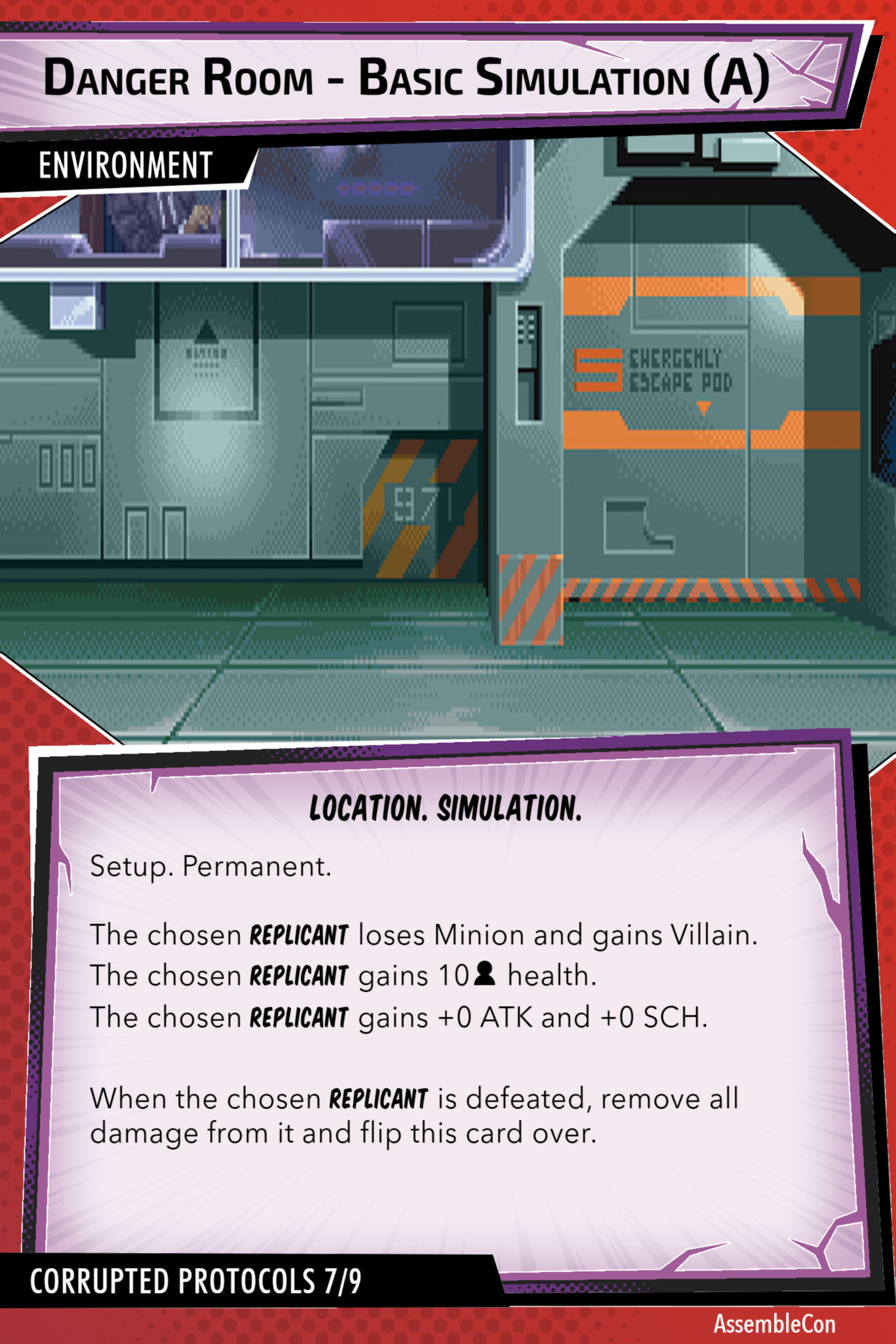
Environment
This is where your simulation begins.
Basic Simulation (A) is the easiest of the three Danger Room options, but it still changes how you’ll approach the encounter. Its permanent setup effect transforms the chosen Replicant from a minion into a villain.
The chosen Replicant gains 10 health, along with the Villain trait, while losing its Minion trait. Its attack and scheme values receive no additional bonuses from this effect.
Your objective is to defeat the Replicant. When the chosen Replicant is defeated, remove all damage from it and flip the Danger Room card over. Defeating this enemy is how you complete the simulation.
Why it matters: Basic Simulation (A) establishes the core objective of the Danger Room: select a Replicant from your chosen mod sets and defeat it as your villain. The challenge comes from the Replicant’s abilities and the other encounter cards introduced by your selected mod sets.
Safety Override
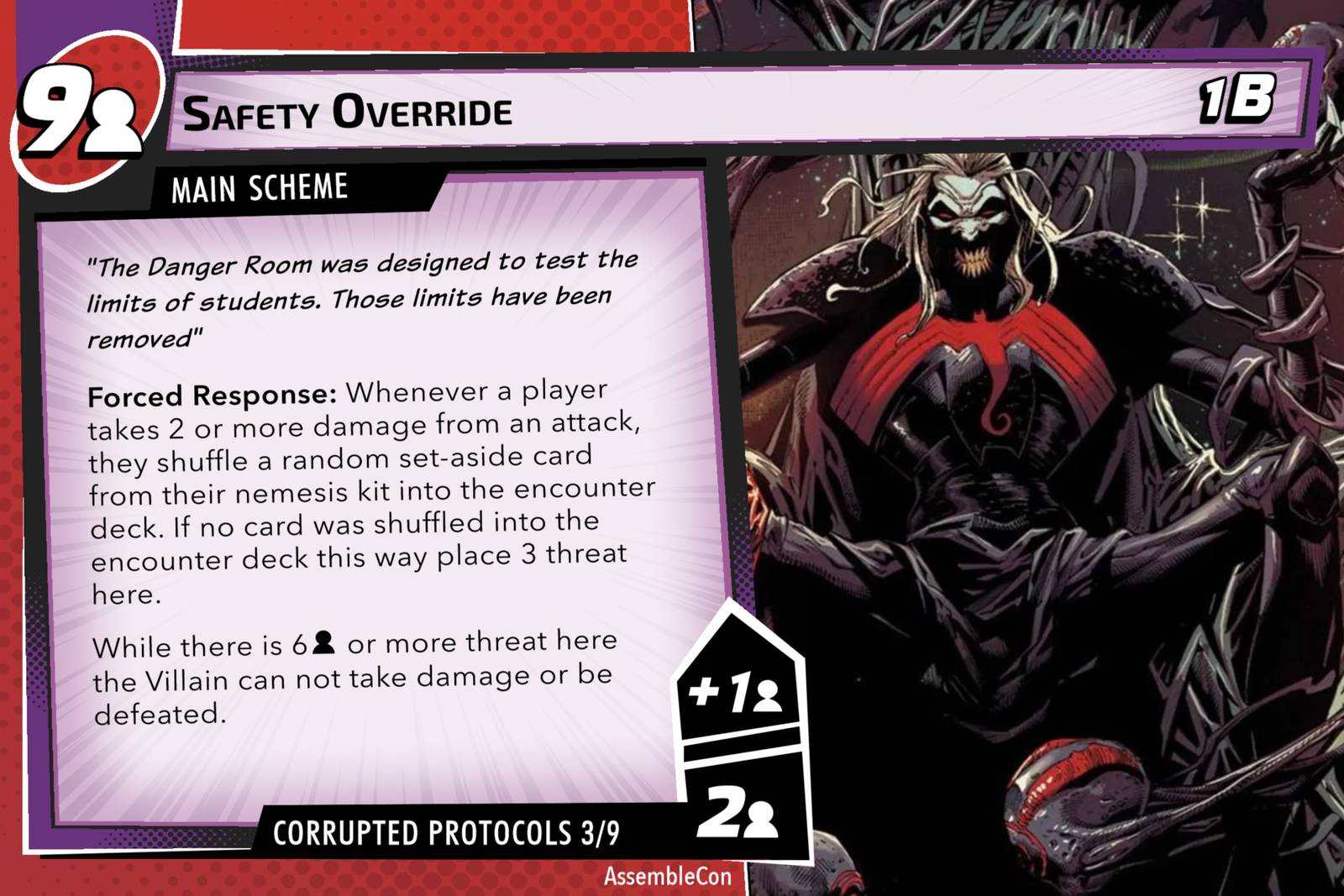
Main Scheme — Corrupted Protocols 3/9
Not everything in the Danger Room goes according to plan.
Safety Override introduces a threat-based mechanic that can make the encounter increasingly dangerous. Whenever a player takes two or more damage from an attack, they shuffle a random set-aside card from their nemesis kit into the encounter deck.
If no card is shuffled into the encounter deck this way, place three threat on Safety Override instead.
That threat creates a serious problem: while Safety Override has six or more threat on it, the villain cannot take damage or be defeated.
Why it matters: Safety Override forces players to think carefully about incoming attacks and the consequences of allowing threat to accumulate. The villain may be right in front of you, but if the main scheme reaches its threshold, simply dealing damage won’t be enough to win.
As its flavor text puts it, the Danger Room was designed to test the limits of its students. Those limits have been removed.
Venom
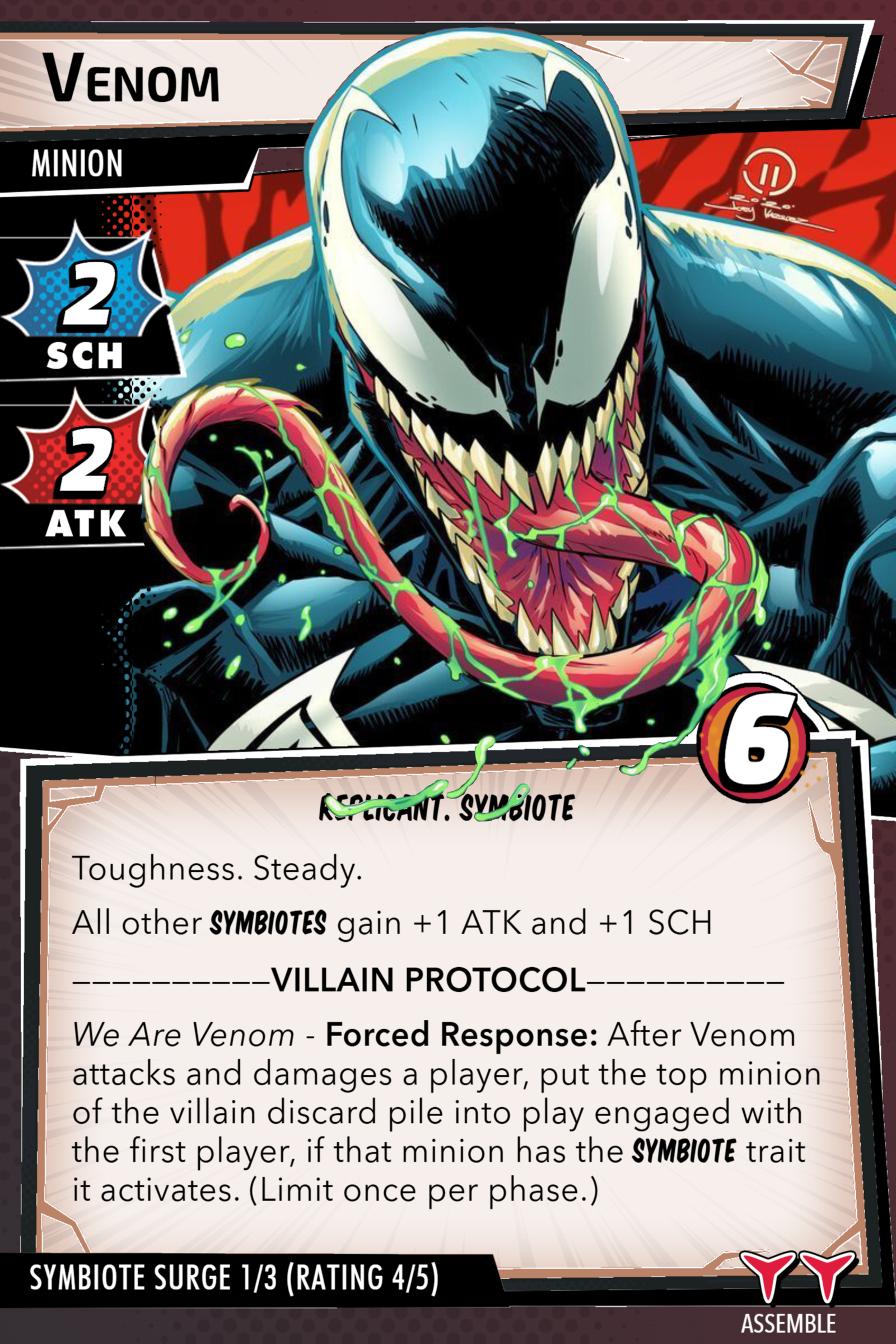
Minion — Symbiote Surge 1/3 | Rating: 4/5
Venom is a great example of how a mod set can introduce more than just another enemy to fight.
With 2 ATK, 2 SCH, and 6 health, Venom is already a threat. He also has the Symbiote and Replicant traits, making him a natural fit for a Danger Room encounter.
His card includes the keywords Toughness and Steady, while his passive ability gives all other Symbiotes +1 ATK and +1 SCH.
But his Villain Protocol is where things get especially interesting.
We Are Venom — Forced Response: After Venom attacks and damages a player, the top minion of the villain’s discard pile enters play engaged with the first player. If that minion has the Symbiote trait, it activates. This ability is limited to once per phase.
Venom doesn’t just threaten the heroes himself. He can also bring additional enemies back into the fight, and Symbiote minions can immediately become even more dangerous.
Why it matters: The Symbiote Surge mod set creates pressure that can build throughout the encounter. If Venom becomes your chosen Replicant, you’re turning an enemy with an ability that can repopulate the board into your primary opponent. The other cards in your selected mod sets can add even more complications to the fight.
Build Your Own Simulation
These three cards offer a glimpse of what the Danger Room can do. One simulation establishes the rules, a main scheme introduces a dangerous condition, and a mod set supplies an enemy with mechanics that can change the entire encounter.
Now imagine combining Venom with two or three other mod sets. What other Replicant will become your villain? Which encounter mechanics will work together? And which heroes will be best equipped to handle the resulting challenge?
With three Danger Room simulations and a wide selection of mod sets to combine, the experience is yours to build.
Choose your simulation. Select your mod sets. Enter the Danger Room.
Your next challenge awaits.